
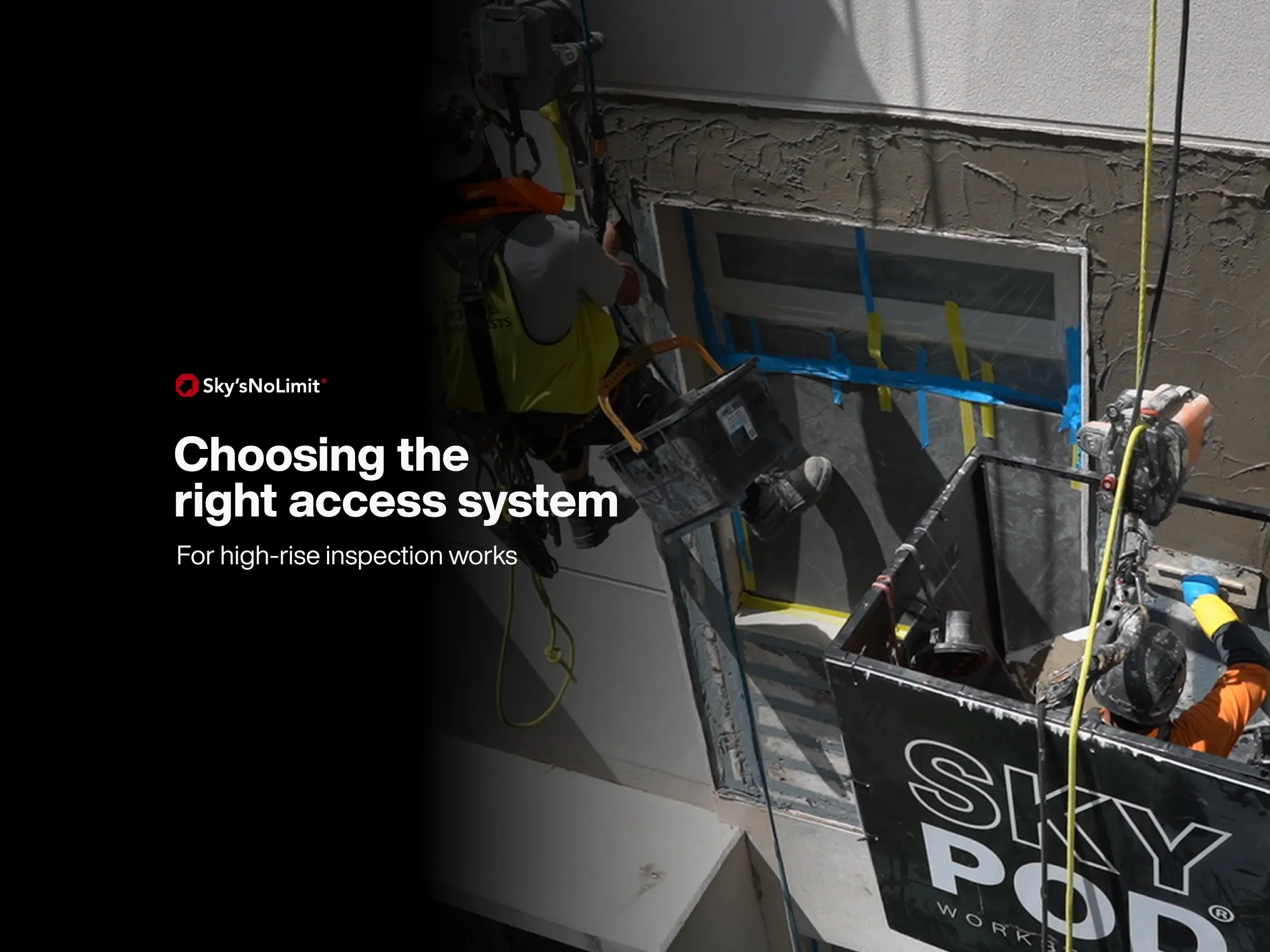
The five common access methods
There are five access methods commonly used for high-rise façade inspection in Australia. Each has its own operating envelope, cost profile and constraints. Scaffolding provides continuous platform access across an entire elevation but is slow to erect and dismantle, and dominates project cost on inspection-only scopes. Building maintenance units, or BMUs, are roof-mounted cradles fixed to the structure, typically installed during original construction. They are well suited to routine cleaning and inspection on buildings designed with them in mind, but constrained to specific buildings and patterns of movement. Swing stage platforms are temporary suspended platforms, suspended from the roof by motorised winches. They suit medium-rise façade access but are constrained on building geometry, particularly setbacks, balconies and non-vertical features, and are sensitive to wind. Conventional non-mechanical rope access (abseiling) provides flexibility across complex geometry but requires significant physical effort for repeated ascent across a substantial inspection scope. PEARS® powered elevation deploys the same rope-based safety framework with motorised ascent, removing the climbing fatigue and supporting longer continuous work.
Factors that drive selection
Building height is the first factor. PEARS® powered elevation is deployed across the full high-rise range, from around 10 metres up to 300 metres and beyond. BMUs are constrained to where they were installed at construction. Scaffold becomes complex and expensive across the entire high-rise range. Inspection duration is the second factor. For a one-week inspection scope, multi-week scaffold setup cannot be justified. For a multi-month full-façade renewal, scaffold setup duration is a smaller proportion of total programme, but PEARS® still wins on cost, disruption and flexibility. Building condition affects which anchors and structural elements can carry rope-based loads. Occupancy profile (residential versus commercial versus mixed use) drives sensitivity to scaffold encapsulation. Weather exposure on coastal sites can drive the choice toward higher IP-rated equipment, which is where the MODE Smart Spider Pro MAX with IP65 protection becomes relevant. Frequency of return inspection is another factor: a system that supports repeat access without each visit triggering a new scaffold cycle has clear commercial advantages over a programme life. Permanent anchorages installed by CPR Group remain in place across decades of asset life.
Where PEARS® powered elevation suits inspection works
Inspection scopes share specific characteristics that make PEARS® powered ascender systems well suited. Active inspection time per panel or element is typically short, often minutes per inspection point. The number of access points across a façade is high, requiring frequent movement vertically and laterally. Scaffold occupancy time on these scopes would vastly exceed active inspection time, making the access method dominate project cost and programme. PEARS® flips this ratio. Setup is in a single shift. The MODE Smart Spider powered ascender system moves quickly between inspection points at variable speeds up to 20 to 22 m/min, with descent up to 37 m/min. Inspection findings can be documented in real time, with powered ascent allowing fluid movement back to specific concerns identified earlier in the drop.
Inspection efficiency benefits
Three efficiency benefits matter on a typical façade inspection. First, calendar duration reduces, often substantially, because the access method does not impose its own setup and dismantle window on the programme. Second, labour utilisation improves, because the same competent PEARS technicians operate the access system and the inspection. Third, the inspection itself is more thorough, because operators arrive at each inspection point with reserves intact, supporting more careful observation and documentation. On the Meriton Towers Parramatta case study, a 60 storey ultra high-rise inspection was completed in 3 weeks by 2 operators, with no scaffold installed. That outcome would not be replicable with any of the four other access methods on the same scope and programme.
A simple decision framework
Building managers and asset owners approaching an inspection access decision can apply a five-step framework. Step one: confirm building height and identify whether a BMU is already installed and suitable for the scope. Step two: estimate active inspection duration in shifts or days. Step three: estimate access method setup and dismantle duration for each candidate method. Step four: compare the ratio of active work to total access time. Step five: weigh occupancy disruption, weather exposure and frequency of return access against the cost comparison. Where active work is less than half the total access time under scaffold, powered ascenders typically win on cost and duration. Where occupancy disruption is highly visible, powered ascenders typically win on amenity. Where frequent return inspection is expected over a building's life, powered ascender access integrates more easily into ongoing asset management through permanent anchorages installed once and used for decades.
Beyond inspection: maintenance, remediation, consultancy
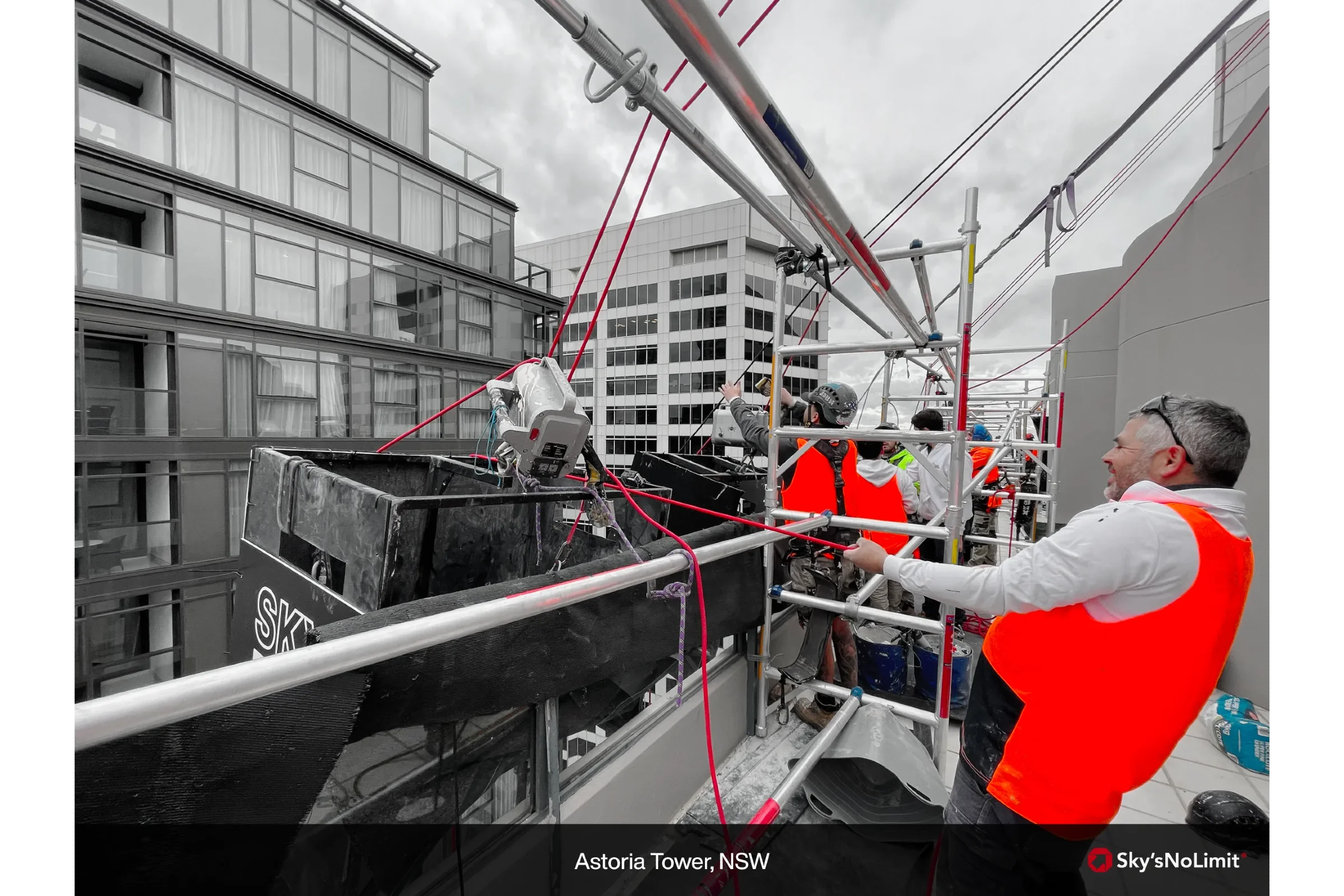
PEARS® powered elevation is increasingly the practical choice not just for inspection, but for any work on a high-rise façade where speed, flexibility and minimal disruption matter. Maintenance access, sealant and coating works, glazing replacement, targeted remediation, full façade renewal, and detailed consultancy inspections all sit inside the same framework. The Astoria project (12 tonnes of render removed and 12 tonnes reinstalled) and Blacktown project (over 5 tonnes of rubble removed with jackhammers via rope-based access) demonstrate that heavy work is well within the framework's capability. A single PEARS® setup can support consultancy investigation, scoping, costing, remediation, and ongoing asset care across decades of a building's life. The combination of permanent anchorages, the MODE Smart Spider and the SkyPod® workstation makes the framework the practical answer for the full lifecycle, not just one phase of it.
Frequently asked questions
- What is the best access method for high-rise façade inspection?
- On most high-rise inspection scopes, PEARS® powered elevation offers the strongest combination of cost, duration, flexibility and minimal disruption. Where a BMU is already installed and matches the inspection pattern, that may be the simpler choice for routine inspection on that specific building.
- Can powered ascenders inspect any height of building?
- Yes. The MODE Smart Spider Pro MAX supports up to 450 m of running distance on a single battery under standardised load, and is deployed across the full high-rise range from around 10 metres up to 300 metres and beyond.
- How does a BMU compare to a powered ascender for inspection?
- A BMU is fixed to the building and follows the cleaning and inspection patterns it was designed for, with limited flexibility on geometry. A powered ascender is portable, deployable across multiple sites and building types, and supports more flexible inspection scopes.
- How often should high-rise façades be inspected?
- Inspection frequency depends on building age, construction type, location and condition. Façade engineers and asset consultants advise on specific intervals. Many strata buildings inspect on a 3 to 10 year cycle, with more frequent visual inspections in between.
- Does heavy material handling rule out scaffold-free access?
- No. The Astoria project (12 tonnes of render removed and 12 tonnes reinstalled) and Blacktown project (over 5 tonnes of rubble removed with jackhammers) were both delivered through the PEARS® framework without scaffold. The framework supports davit arms, multiple ascenders in parallel, and the MARS system for 6 to 8 façade technicians on one elevation.
The right access method depends on the building, the work and the programme. PEARS® powered ascender systems are increasingly the practical choice for high-rise work across the full lifecycle, where speed, flexibility, minimal disruption and long-term asset care matter. To request an inspection access assessment, contact the SNL team for a structured method comparison.