
What does PEARS® stand for and where did it come from?
PEARS® is the acronym for Powered Elevated Access Rope Systems. The framework was developed inside CPR Group, drawing on more than 30 years of façade remediation and access experience, and is now used across more than 400 completed Australian façade projects. PEARS® was created from a practical need: conventional abseiling, while well-known internationally, was never designed for sustained heavy trade work, material handling or efficient repeated ascent. PEARS® closes that gap. The framework brings the power elevator (the MODE Smart Spider), the rigging methodology, the safety controls and the operator workflow into a single, documented system aligned with Australian standards and CPR Group's real-world project conditions. It is delivered through the PEARS® framework on the CPR Group site and the PEARS® Elevation Academy training programme.
PEARS® versus conventional abseiling
Conventional abseiling, associated internationally with the IRATA training group, is a traditional non-mechanical system that uses no powered devices. It is well-known and remains the most popular rope-based access method internationally. Its training and certification focus on rope handling, descent, and rescue. It does not include training on the actual trade work that needs to be done at the work face, such as drilling, painting, sealant application, concrete repair, or controlled material handling. PEARS® takes a fundamentally different position. It is a non-conventional mechanical access framework built around powered elevation, designed for the work itself. The MODE Smart Spider acts as the engine for lifting and descent, removing the muscular climbing component. The technician arrives at the work face with full physical reserves and focuses on the trade task. Material handling, tool lifting, multi-operator MARS (Multiple Access Rope System) deployments and the SkyPod® workstation all sit inside PEARS®. Where abseiling is about getting somewhere on a rope, PEARS® is about delivering the work.
The four pillars of PEARS®
The first pillar is equipment. PEARS® is delivered around the MODE Smart Spider powered ascender system as the power elevator, supported by 11mm EN1891 Type A static rope, back-up devices, anchorage systems, material handling attachments, and the SkyPod® workstation for extended façade work. The second pillar is methodology. This covers rigging sequences, anchor selection and installation, drop planning, line management, controlled material lifting, upselling (the ascent process) and down sailing (the descent process), MARS configurations for multi-operator work, and operator routines for ascent, positioning and trade execution. It defines how the equipment is configured and used across a project. The third pillar is safety, embedding two-line redundancy, independent anchorages, Safe Work Method Statements aligned with AS/NZS ISO 22846, pre-use checks, hazard reviews, communication protocols, and emergency procedures. The fourth pillar is competency, delivered through the PEARS® Elevation Academy and operator familiarisation, ensuring people deploying the equipment are competent in both the system and the trade work it supports.
PEARS® training is about the work, not just the rope
The biggest difference between PEARS® training and conventional abseiling training is the scope. Conventional abseiling courses spend most of their time on harnessing, descent, ascent on mechanical ascenders, and rescue scenarios. Tools, materials and the actual trade are largely absent. The reality of decades of CPR Group façade work tells a different story: rescues are rare. Across 50 years of combined experience on Australian high-rise façades, the team has not had to perform a rescue on a job. The training that matters every day is about doing the work safely and productively. PEARS® training covers system setup, daily inspections, operator routines, fault recognition, emergency procedures, material handling, and the documentation flow expected on a typical project. It also covers the trade work component: how to handle tools at height, how to drill and contain concrete dust, how to apply coatings and sealants from a powered platform, how to integrate SkyPod® workstations into a programme, and how to plan a façade scope across a fleet of operators. The programme is delivered by practitioners with significant field experience, not classroom-only trainers.
Material handling within PEARS®
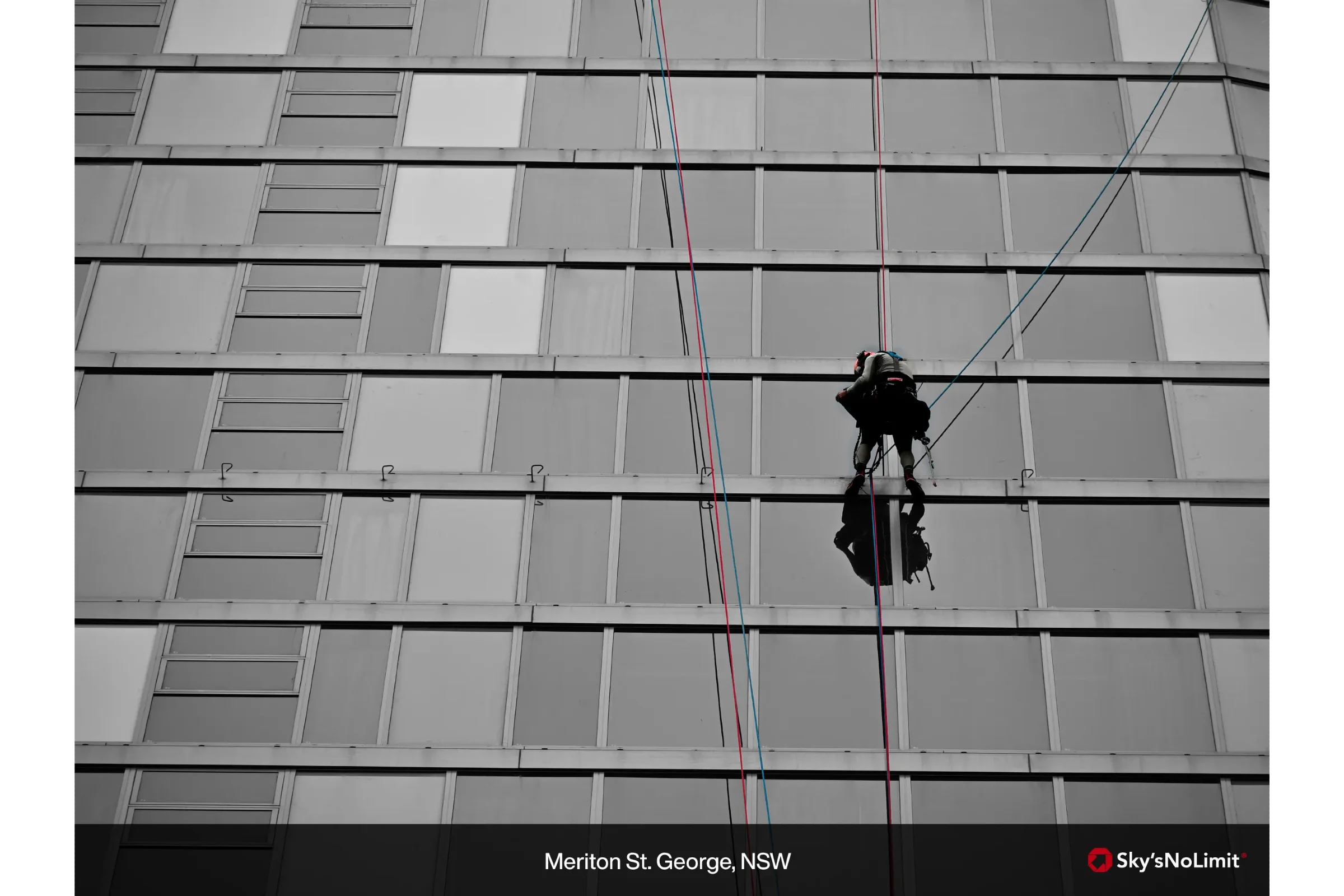
A significant portion of effort on vertical works is moving tools and materials between ground and the work face. Conventional abseiling has no integrated solution for this, beyond manual hauling on auxiliary ropes. PEARS® integrates material handling into the same powered ascender setup. A typical example is a façade technician at ground level using a handheld remote to haul a sheet of glass up the building to a specific elevation, then ascending separately to receive it at the work face. Davit arms, anchored pulley arrangements, multiple ascenders in parallel for higher lifting capacity, and MARS configurations for 6 to 8 technicians working simultaneously on a single elevation all sit inside the framework. CPR Group projects such as Astoria (12 tonnes of render removed and 12 tonnes reinstalled) and a Blacktown property (over 5 tonnes of rubble removed with jackhammers via rope access) demonstrate the scale of work the framework supports.
PEARS® training and the path to formal accreditation
The PEARS® Elevation Academy currently runs as a competency-based programme, not a Registered Training Organisation. That is changing. The Academy is affiliating with Allen's Training Group, a long-established RTO in Australia, with certificates to be issued under the SNL/CPR brand under their wings. This affiliation strengthens credibility with Safe Work Australia, the Federal Safety Commission and clients with formal training requirements, while keeping PEARS® content focused on the trade-based, real-world curriculum that the Academy has built. Course participants typically arrive with a current white card and working at heights training. PEARS® adds the manufacturer-specific MODE familiarisation, the rigging methodology, the trade-work components and the documentation discipline. Contact the Sky's No Limit team to enquire about PEARS® operator training schedules and content.
Frequently asked questions
- Is PEARS® a certification or a methodology?
- PEARS® is a methodology and operational framework, delivered through competency-based training within the PEARS® Elevation Academy. The Academy is affiliating with Allen's Training Group (an RTO) so that certificates can be issued under the SNL/CPR brand with that organisation's accreditation behind them.
- How is PEARS® different from conventional abseiling?
- Conventional abseiling uses no mechanical lifting devices and focuses training on descent, ascent and rescue, with no trade-work component. PEARS® is a non-conventional mechanical access framework built around the MODE Smart Spider power elevator, designed for delivering trade work, material handling and multi-operator façade scopes.
- Who developed the PEARS® framework?
- PEARS® was developed within CPR Group, drawing on more than 30 years of façade remediation experience and over 400 completed Australian projects. Sky's No Limit applies it as the operational framework for MODE power elevator deployments in Australia.
- What does PEARS® training cover that abseiling training does not?
- Real trade work at the work face: how to drill, handle and contain concrete dust, apply coatings and sealants from a powered platform, integrate the SkyPod® workstation, manage material handling, configure MARS for multi-operator scopes, and plan a façade programme across a fleet.
- Is PEARS® recognised internationally?
- PEARS® is an Australian framework operated by Sky's No Limit and CPR Group. It aligns with internationally recognised equipment standards (EN, IEC) and Australian work-at-height standards (AS/NZS ISO 22846).
PEARS® is the structured framework that brings equipment, methodology, safety and real-world trade training together as one system. It is non-conventional, mechanical, faster and safer than the alternatives, and built specifically for Australian façade work. To enquire about PEARS® operator training or learn more about how the framework applies to a specific project, contact the Sky's No Limit team.