
Why operator fatigue matters
Fatigue is recognised by Safe Work Australia, fatigue at work as a significant workplace hazard. It affects reaction time, decision-making, hazard recognition, motor coordination and judgement under pressure. In rope-based access work, where every action is performed at height under safety-critical procedures, these effects translate directly into elevated operational risk. Beyond safety, fatigue has commercial consequences. Productivity declines through the day as physical capacity reduces. Error rates rise on detailed tasks like sealant application, panel inspection or coating coverage. Crew rotation requirements limit total daily output. On a programme that depends on consistent quality across many ascent cycles, fatigue is a measurable cost line, even when it does not show up as a separate item on a project budget. There is also a workforce sustainability dimension. Rope access is a physically intensive trade with a finite career length under traditional non-mechanical methods. Reducing the fatigue load extends practical careers and helps retain experienced façade technicians in the industry.
Energy expenditure: manual versus powered ascent
Manual rope ascent on mechanical ascenders is documented in occupational health literature as a high-intensity activity, comparable in metabolic cost to climbing stairs while carrying additional weight. A technician ascending 30 metres on the rope expends meaningful energy before any productive work has been done. The effort involves repeated alternation of upper-body lift and lower-body weight transfer, with sustained grip pressure on the ascender handles. Multiply that by 4 to 8 ascent cycles in a typical shift and the cumulative load is significant. By mid-afternoon, a technician on a manual programme is operating with reduced physical reserves, and that reduction affects everything from grip strength on tools to attention span during inspection. Powered elevation uses the MODE Smart Spider powered ascender system, transferring the lifting work from the operator's muscles to a 1000W electric motor. The operator's physical contribution becomes one of positioning, control and trade work, not vertical movement. This is the primary fatigue benefit.
Injury patterns associated with manual ascent
Documented injury patterns in conventional rope access include repetitive strain injuries in the shoulders, elbows and wrists from sustained ascender operation, lower back issues from the alternating weight transfer of leg-and-arm climbing, and hand and grip strength deterioration over career duration. These are cumulative injuries, building over many projects and many ascent cycles, often only becoming functionally limiting after years in the trade. Powered elevation does not eliminate these risks entirely, because rigging, positioning and trade work still involve physical effort. But it removes the largest single contributor, the repeated lifting of body weight on mechanical ascenders. The reduction in cumulative load is directly relevant to long-term operator health and career length.
How powered ascenders reduce strain
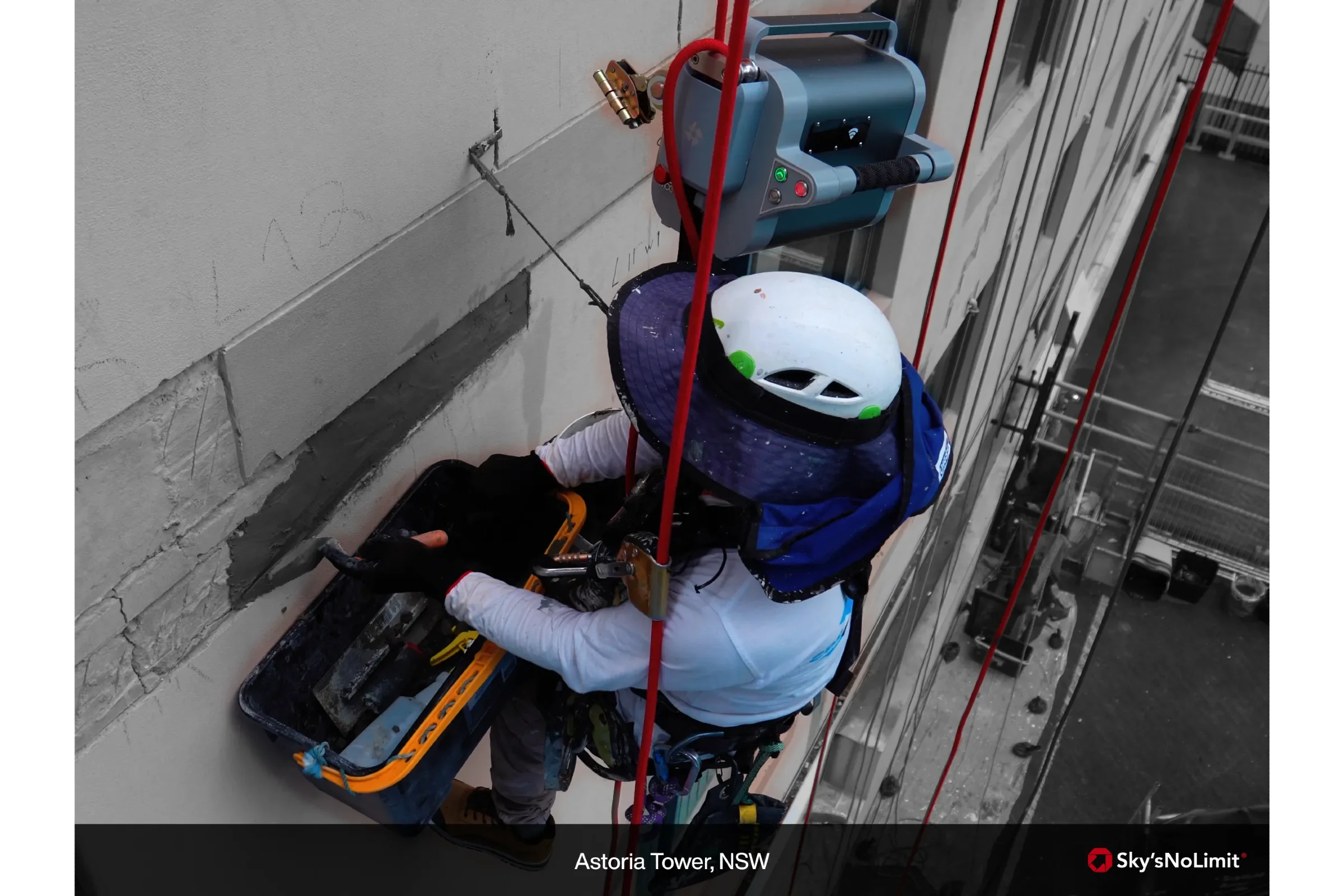
Three specific effects matter on a working day. First, the upper body lifting effort of manual ascent is removed. Second, repetitive shoulder, elbow and grip strain associated with mechanical ascender operation is significantly reduced. Third, recovery time between ascent cycles is shorter, because the operator is not depleted from the climbing component before they begin trade work. Cumulatively, this allows operators to maintain higher attention and output across a longer working day. It also enables more demanding trade work to be undertaken at the work face, because the operator arrives there with reserves intact rather than depleted from the climb.
Operator endurance across a programme
Fatigue accumulates not only across a shift but across a programme. A 3-week inspection or remediation project involving daily ascent cycles imposes a cumulative load on the team that affects performance in the later weeks. Operators arrive at week three carrying a deficit that has been building since day one, and quality starts to dip across detailed tasks. Powered elevation levels this curve. Operators arrive at week three with reserves largely intact, supporting consistent quality and judgement through to project completion. On the Meriton Towers Parramatta inspection scope, a 60-storey programme was completed in 3 weeks by 2 operators. That scale of vertical work would be physically demanding without powered ascent, and the consistency of output across the programme would be difficult to maintain.
Crew rotation and labour utilisation
Under manual rope access, crews typically rotate between climbing days and lighter days to manage fatigue across a programme. Powered ascent reduces the need for this rotation, because the climbing load that drives the recovery requirement is removed. A two-operator team can sustain consistent output across consecutive days without the same recovery overhead. This translates into more efficient labour utilisation across a programme, particularly on time-pressured inspection or repair scopes where consistent daily progress is needed.
Comfort, positioning and the SkyPod® workstation
Operator positioning at the work face also affects fatigue. Hanging from a rope in a harness for extended periods produces its own discomfort, separate from climbing strain. The harness loads the pelvis and upper thighs, and extended stationary work at a single point becomes uncomfortable even with the best modern harness designs. The SkyPod® workstation developed by CPR Group provides an engineered platform that pairs with the powered ascender. It reduces harness pressure and pelvic strain during extended stationary work at a single work point, supports added comfort and safety, and can be configured with multiple seating positions for staged work or multi-operator scopes. The combination of powered ascent and the SkyPod® addresses both the moving and the stationary components of fatigue across a working day.
Frequently asked questions
- Does powered ascent reduce the physical requirements for façade technicians?
- It reduces the physical demand of the climbing component, but operators still require the strength and fitness to manage rigging, positioning, emergency procedures and trade work. Powered elevation changes the work, it does not replace operator competency.
- How does fatigue affect safety on rope-based access works?
- Fatigue degrades reaction time, decision-making and motor control, all of which are safety-critical when working at height. Reducing physical fatigue supports clearer judgement and more consistent procedure compliance.
- Can powered ascent extend a working day?
- It can support more productive hours within a shift by reducing the physical depletion caused by manual ascent. Working hours themselves are governed by fatigue management policies and applicable awards, not equipment capability.
- What is the role of the SkyPod workstation in fatigue management?
- The SkyPod is an engineered work platform that pairs with the powered ascender, reducing harness pressure and pelvic strain during extended stationary work, complementing the moving-component benefits of powered ascent.
- Does powered ascent affect career length for façade technicians?
- By reducing the cumulative load of manual climbing across a career, powered elevation supports longer practical career duration. The repetitive strain injuries associated with mechanical ascender operation are the primary career-limiting factor that powered ascent addresses.
Fatigue is a safety, productivity and workforce sustainability issue, and it has been an accepted cost of conventional rope access for decades. Powered elevation addresses the largest physical contributor to that fatigue without changing the safety framework around the work. To discuss how powered ascender deployment supports your team's productivity and safety profile, speak to the SNL team.