
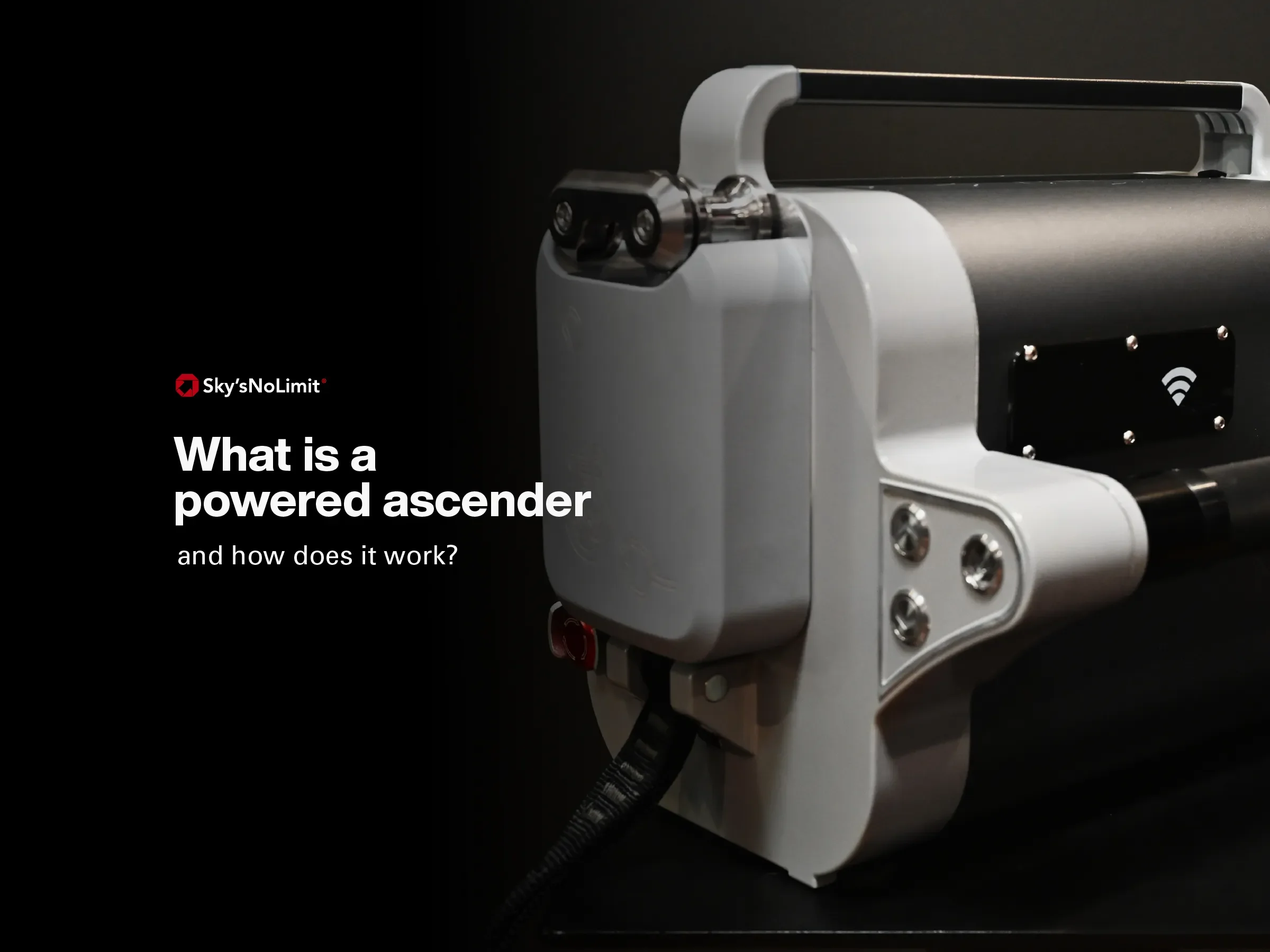
What is a powered ascender?
A powered ascender, or power elevator, is a portable motorised device that attaches to a working rope and uses an electric motor to drive controlled ascent and descent. It is operator-mounted within the PEARS® framework, where the technician wears it on harness, manages speed through a handheld controller, and stays in direct command of the vertical movement at all times. Power is supplied by a hot-swappable lithium battery integrated with the unit. One charged battery typically supports up to a full day's work, and operating with two batteries on rotation removes any practical limit on programme duration. Sky's No Limit is the exclusive Australian distributor and authorised service provider of the MODE Smart Spider powered ascender system, the unit referenced throughout this guide for technical figures. The MODE platform has been in international service for around two years, with continuous product development informed by field feedback from operators and contractors using the system in real conditions. The Smart Spider is the prime mover within the PEARS® framework: a non-conventional mechanical access system that replaces the manual climbing component of conventional rope access.
How does a powered ascender work?
The MODE Smart Spider Pro Series runs on a 1000W permanent magnet motor paired with a 36V 5000mAh hot-swappable battery. The motor drives a friction grip onto an 11mm static rope conforming to EN1891 Type A, lifting or lowering the technician along the line. Permanent magnet motors are chosen for this application because they deliver high torque at controlled speeds and produce less heat across continuous duty cycles than brushed alternatives. Speed control is variable. The operator sets ascent rate anywhere from 0 m/min up to 20 m/min on the Pro and up to 22 m/min on the Pro MAX, with descent rates variable up to 37 m/min on both models. Variable speed matters because work tasks are rarely uniform. Inspection cycles need slow controlled movement to look closely at panels, while transit between work points uses higher speeds. Safety functions are integrated into the unit. A controlled braking system holds position on demand and locks automatically if the operator releases the controller. An automated emergency descent function operates if power is interrupted, lowering the operator under controlled braking. The drive mechanism is fully enclosed. The safe working load is 200 kg, with rescue load capacity rated up to 250 kg. Running distance on a single battery, under a 100 kg operator load, is approximately 330 m on the Pro and 450 m on the Pro MAX. These figures are drawn from the MODE technical specifications.
How a power elevator differs from a winch
The distinction matters because winches and power elevators are sometimes confused in procurement conversations. A winch is anchored to a fixed structure and the load travels by reeling line in or out. A power elevator travels along the rope itself, with the rope fixed and the device moving. This is what allows the operator to be the moving element on a rope rigged from a roof anchor far above. The practical implication is that a power elevator works on any vertical scope where rope can be safely rigged from above. It does not require structural mounting points at the work location, unlike a winch or a building maintenance unit. This makes it suited to ad-hoc access on buildings that were not designed with permanent rope access infrastructure.
Key components of a complete PEARS® system
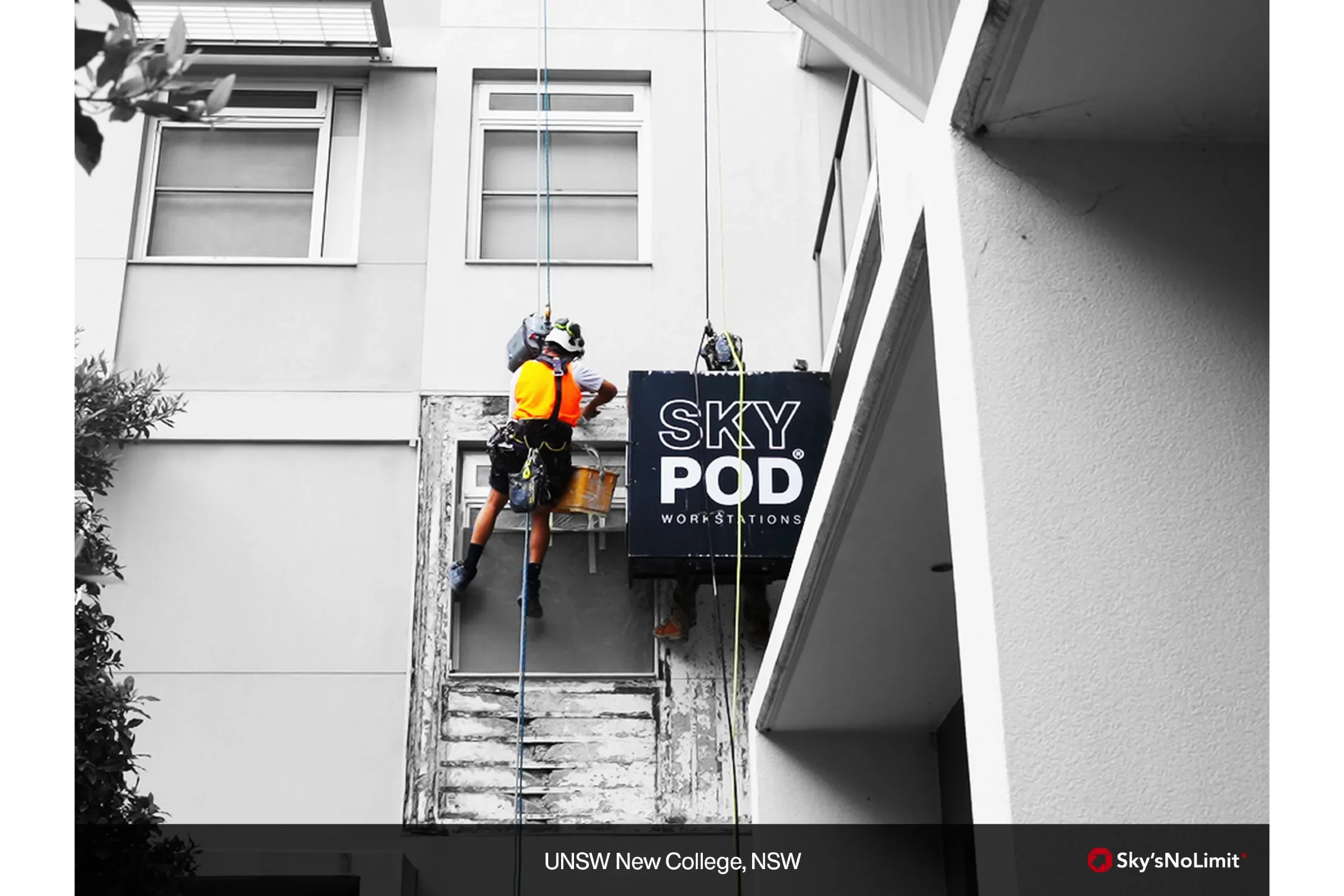
A working PEARS® system has four elements operating together. The first is the powered ascender itself, providing the motor, battery, drive mechanism and operator controls. The second is the working line, an 11mm EN1891 Type A static rope rigged from an independent anchor at the roof. The third is a separate safety line on its own anchor, with a back-up fall arrest device on the operator harness, providing two-line redundancy and rope access safety principles. The fourth element is the rigging and anchorage, configured by a Competent PEARS technician under a project-specific Safe Work Method Statement. Anchorage points are typically installed by the SNL/CPR team before a project begins. These are permanent and continue for the life of the building, with annual inspection and certification required for safe use. This is one of the most important differences between PEARS® and conventional abseiling: the system is engineered into the building once, then used repeatedly across decades of asset life. Optional components extend the system's working envelope. Material handling attachments support controlled lifting of tools and supplies, either alongside the operator or external to them. A typical example is a façade technician standing at ground level using a handheld remote (or the current app) to haul a sheet of glass up the building, then receiving it at the work face after ascending separately. This removes the need to haul materials manually on auxiliary lines. The SkyPod® workstation engineered by CPR Group is the encapsulated façade work platform that pairs with the powered ascender for extended task duration, providing added comfort, safety, and the option to attach multiple seats for staged work.
Where powered ascenders fit within Australian rope access
Powered ascenders sit inside the PEARS® framework, which CPR Group has built over more than three decades to deliver façade access on Australian buildings. The framework references Australian Standards (AS/NZS ISO 22846, which now governs rope access systems in Australia, having superseded AS/NZS 4488). Rigging, operator competency, project documentation and rescue planning all continue to apply under these standards. The powered ascender takes over the climbing component that was previously done manually under muscular effort using hand and foot mechanical ascenders. This is the central operational change. The safety architecture and the documentation stay the same. What changes is the physical work itself. A 30 metre ascent that previously required the operator to climb under muscular effort now happens under controlled motorised lift, with the operator's attention free to focus on the trade work rather than the climb. IRATA, the international body associated with conventional abseiling, is a traditional, well-known training group that does not use mechanical lifting devices. PEARS® is the non-conventional mechanical alternative built around the powered ascender.
Where powered ascenders are deployed in Australia
Australian deployments cover applications across high-rise environments including façade remediation, glazing installation and replacement, wind turbine inspection and maintenance, infrastructure such as bridges and towers, painting and coating works, and confined or difficult-to-reach environments. The system is well suited to any project where repeated ascent and descent cycles, heavy material handling, or restricted ground space make scaffold impractical or uneconomical. A useful reference point is the Meriton Towers Parramatta inspection scope completed by Sky's No Limit, a 60 storey ultra high-rise programme delivered in 3 weeks by 2 operators with no scaffold installed. The Astoria project demonstrates the heavy-duty side: 12 tonnes of render removed and 12 tonnes reinstalled, again entirely through the PEARS® framework. CPR Group has also delivered jobs such as a Blacktown property where over 5 tonnes of rubble was removed using jackhammers through rope access. Heavy work is not the limit of PEARS®, it is one of its strengths.
Frequently asked questions
- What is the difference between a manual ascender and a power elevator?
- A manual ascender requires the technician to climb under muscular effort using mechanical hand and foot devices gripping the rope. A power elevator (powered ascender) uses a battery-driven electric motor to drive the technician up and down under controlled speed, removing the physical climbing effort.
- Do power elevators require special qualifications to operate?
- Yes. In Australia, rigging and operation are typically carried out by Competent PEARS technicians who hold a current white card and working at heights training, plus manufacturer-specific MODE familiarisation through the PEARS® Elevation Academy.
- Can a powered ascender be used with any rope?
- No. The MODE Smart Spider Pro Series is designed for use with EN1891 Type A static rope at 11 mm diameter. Operating outside this specification falls outside the manufacturer's approved configuration.
- How long does a battery last on a powered ascender?
- One charged 36V 5000mAh battery typically supports up to a full day's work on the MODE Smart Spider. Batteries are hot-swappable, so operating with two batteries on rotation removes any practical limit on programme duration. Running distance on a single charge under a 100 kg operator load is approximately 330 m on the Pro and 450 m on the Pro MAX.
- Are powered ascenders safer than manual rope access?
- Yes, by a great deal. Power elevators increase safety in a number of key ways: they reduce overall operator fatigue, act as the engine for lifting and descent (saving operator energy so they remain alert), avoid the need to continuously climb to the roof to descend (removing the repeated risk of climbing through manholes or traversing slippy roofs), remove the risk of setting up over roof edges (all setup is done at ground level), assist with lifting tools, materials and supplies, and can be rapidly deployed for rescue at up to 5 times the speed of a manual rescue. Industry data from Safe Work Australia supports rope-based access as one of the safer working-at-height categories when applied under modern frameworks.
A power elevator is a controlled motorised lifting device that sits at the centre of the PEARS® framework. It changes the climbing component without compromising the safety architecture around it, and it is statistically safer, less costly and more flexible than scaffold or conventional abseiling on the work CPR Group and Sky's No Limit have delivered for decades. To understand which configuration suits your project, speak to the SNL technical team or download the MODE technical specifications.